Latest
Google has fixed the inflated impression logging error, but what do you do with all of that incorrect data?

For nearly a year, Google Search Console inflated impression counts across every site reporting through it. Google have confirmed they have now fixed the issue going forwards, but the historical data won’t be corrected and most brands are about to spend the next twelve months comparing apples to oranges. Here’s what happened, why it matters, and how we’re helping clients reconstruct a defensible picture of what their visibility actually looked like.
What Google has confirmed
On 4 May 2026, Google confirmed it had resolved a logging error that had been distorting Search Console reporting since 13 May 2025. That’s roughly 50 weeks or just under a year of misreported data sitting in everyone’s primary SEO measurement tool.
This is what Google published:
“A logging error prevented Search Console from accurately reporting impressions from May 13, 2025 until April 27, 2026. This issue has been resolved. As a result, you may notice a decrease in impressions in the Search Console Performance report. Only impressions and related metrics — CTR and average position — were affected; clicks were not affected by the error.”
Three things follow from that:
- Impressions during the window were over-reported
- CTR was therefore artificially suppressed, because real clicks were being divided by inflated impressions
- Average position was distorted in ways that are harder to predict but generally pulled towards a worse-looking number
- Clicks themselves are the one metric you can trust across the whole period
Google has also confirmed the historical data will not be corrected. The fix only applies going forward, which leaves every brand with a year of inflated visibility data permanently baked into their reporting and a year-on-year comparison problem that won’t resolve itself until May 2027.
Why this is a bigger problem than it looks
If you only review Search Console at a glance each month, you’ve already started to see the impact. Impressions appear to have dropped from late April onwards, CTR appears to have improved and average position may look different. None of those movements reflect real changes in how Google is showing your pages, in most cases it’s due to the bug being fixed.
The deeper issue is that everything you and your stakeholders have been using to assess SEO performance over the past year sits on top of distorted data:
- Quarterly business reviews, year-on-year visibility narratives
- Content campaign business cases that justified investment on the basis of impression growth
- Forecasts feeding into next year’s budget
- AI Overview impact analyses
All of it is built on a baseline that wasn’t real.
The instinct is to wait it out as by May 2027 the year-on-year comparisons will be like-for-like again. But that’s twelve months of decisions made against data you now know was wrong and twelve months of awkward conversations with stakeholders who’ll see impressions drop and ask why.
What we’ve built
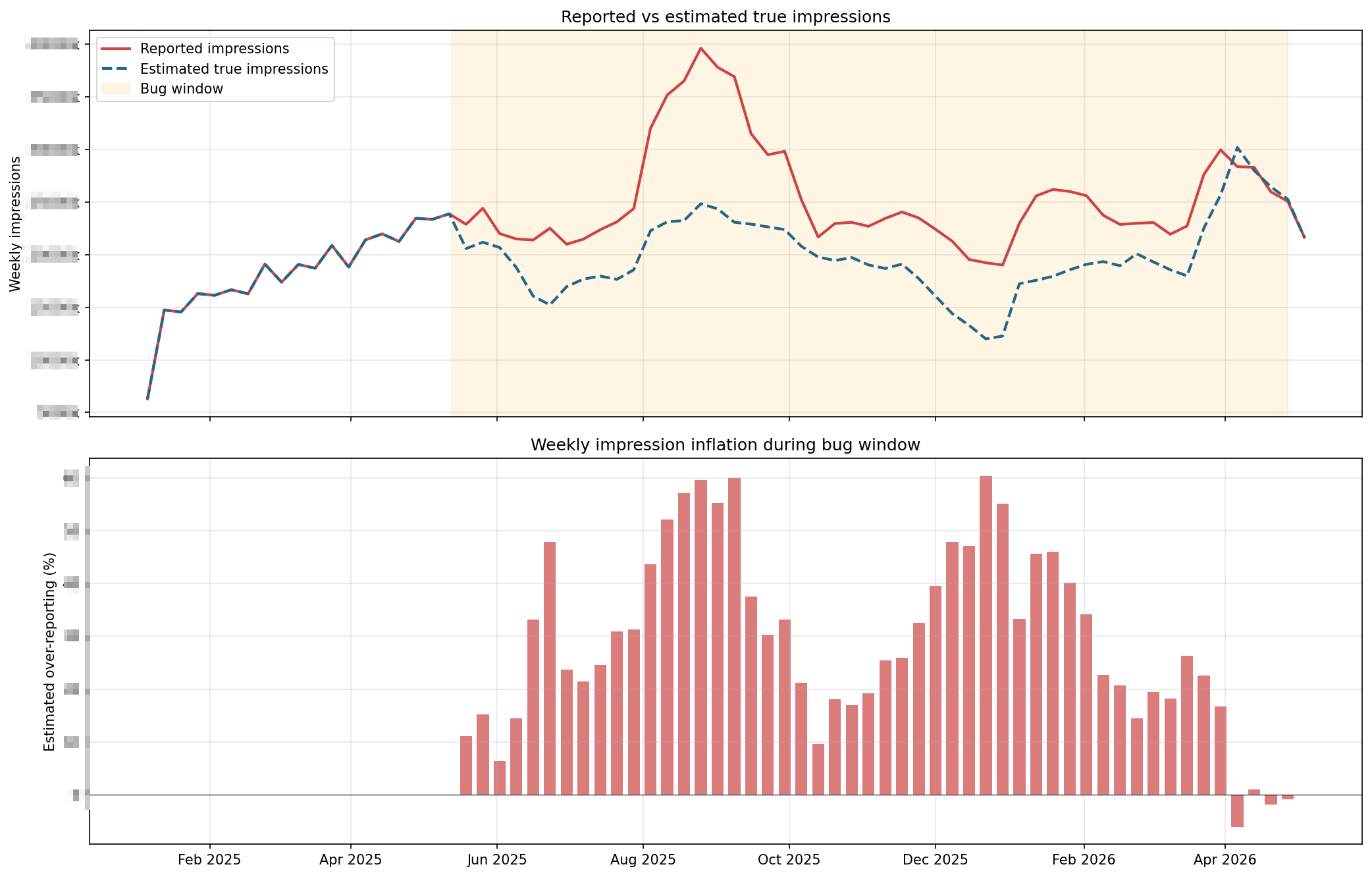
We’ve put together an impression reconstruction model that uses clicks, the one metric Google didn’t break, to estimate what your impressions, CTR and average position would have looked like during the affected window. The principle is straightforward: if clicks are reliable and we have a clean CTR baseline from before 13 May 2025 and after 27 April 2026, we can back-solve a defensible estimate of true impressions for the period in between.
The model handles the things a simple average would miss:
- Structural CTR decline. AI Overviews and SERP feature changes have suppressed CTR independently of this bug. A flat pre-period average would overestimate expected CTR and underestimate true impressions. We fit a trend to clean-period data and project it forward.
- Branded versus non-branded splits. Branded CTR runs an order of magnitude higher than non-branded and the two move differently. A blended baseline hides where the real change happened.
- Sensitivity ranges, not point estimates. We model three scenarios and report a range. Anyone giving you a single number for a year of distorted data is selling false precision.
The output from this model is a day by day and week by week export of what your impressions, CTR and average positions would’ve been and will look something like this:
The caveats matter
It’s important to make clear that this is a model and not a perfect correction. Google has been explicit that the historical data won’t be fixed, so anything we produce is a reconstruction, not the exact truth, as that doesn’t exist. A few specific limitations worth being upfront about:
- The bug’s exact mechanism wasn’t disclosed. If inflation was concentrated in specific surfaces or position ranges, an aggregate model will smooth over a non-uniform distortion
- If your site’s query mix shifted materially during the window due to new content programmes, brand campaigns, ranking shifts, the estimate degrades because expected CTR derived from the pre-period no longer applies cleanly
- Average position is harder to back-solve than impressions because it’s a weighted average that depends on the impression distribution itself. We can give a direction, but the precision is lower
None of which makes the exercise pointless. A range you can defend in a board meeting is more useful than a single number you can’t.
How we can help
We’re running this analysis for Summit clients across retail and ecommerce and we’re happy to do the same for brands we don’t currently work with. What you get is a reconstructed view of your last 12 months of Search Console performance, with clear sensitivity ranges, branded versus non-branded splits and a narrative you can take into stakeholder conversations, so when impressions drop in your next QBR, you can explain exactly why and what the underlying picture really looked like.
If you’d like us to run the analysis on your data, get in touch with our team at hello@summitmedia.com. The sooner the reconstruction is in place, the sooner you stop making decisions against a baseline that was never real.
Ready for change? Let's talk
Speak to Summit