Latest
A Breakdown of the Three Biggest Meta Ads Manager Updates for 2026
The landscape of Meta advertising is shifting rapidly as we move through 2026. Gone are the days of manual rules and granular segmentation; we are officially in the era of ‘Algorithm Partnership’.
Based on the latest updates rolling out in Ads Manager, here is a breakdown of the three biggest changes you need to know to stay competitive.
1. AI-Powered Audience Prompts: Describe Your Ideal Customer
Meta is moving away from the traditional method of manually hunting for interests and lookalike percentages. A new feature currently in testing allows you to simply describe your audience in plain English, and the AI does the rest.
Instead of selecting “Fitness” or “Yoga,” you can now input prompts like:
- “People likely to buy high-ticket fitness coaching”
- “Homeowners in [Area X] interested in a kitchen renovation in the next 6 months”
How it works:
Meta’s AI (leveraging models like Lattice) searches through its massive database of behavioural signals to suggest specific targeting categories. You can then review, remove, or refine these suggestions.
This reinforces that creative is the new targeting. When the AI handles the interpretation of who should see your ad, your edge as an advertiser moves to the offer and the visual assets. If your creative doesn’t resonate, no amount of AI prompting will save the campaign.
2. Advanced Retargeting: Precise Engagement Filters
Retargeting on-platform activity just got a massive upgrade. Meta has introduced two new filters “At Least” and “In the Past” for Custom Audiences on Facebook and Instagram.
You can now refine your audiences based on the intensity and timing of their interaction:
- The “At Least” Filter: Target users who have engaged with your account a specific number of times (e.g., people who visited your profile at least 3 times). This helps you identify and spend more on “high-intent” users.
- The “In the Past” Filter: This allows for “windowing” your retargeting. You can target people who engaged between 30 and 60 days ago, helping you create sophisticated, evergreen re-engagement funnels.
Pro Tip: These filters are best used for accounts with large audience sizes. If your traffic is lower, sticking to broader retargeting windows is still the safer bet to avoid audience exhaustion.
3. The End of Manual Detailed Targeting?
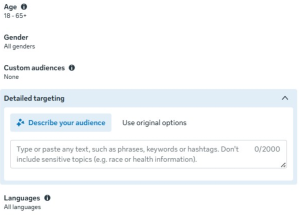
In early 2026, we’ve seen the most aggressive push yet toward Advantage+ Audiences. Meta is increasingly treating detailed targeting as a suggestion rather than a hard rule.
Prompt-to-Targeting: Similar to the new audience description tool, you can now use keywords or hashtags to generate interest lists.
AI Matching: When you hover over a suggested interest, Meta will now explain why it matched that interest to your prompt, giving you more transparency into the “black box.”
Is this actually better?
While it saves time and uncovers hidden interests, the reality of 2026 advertising is that the system is often smarter than our manual selections. Most top-performing accounts are now using these AI prompts only as a starting point (or “suggestions”) alongside broad targeting, allowing Meta’s algorithm to find buyers based on real-time conversion data.
How we are implementing these new features
- AB test: Is it really worth moving away from niche interest stacks? We are testing new AI prompts to give Meta a seed, then let the algorithm expand.
- Auditing Retargeting: If you have the volume, implement the “At Least” filter to segment your “window shoppers” from your “brand fans.”
- Focus on Creative Hooks: Since the AI is making targeting easier, our primary job is to provide diverse creative angles that “speak” to the segments we want to attract.
If you are interested in scaling your paid social, get in touch with the Summit team today.
Ready for change? Let's talk
Speak to Summit